Like Me on Facebook!

Thursday, January 27, 2011


David Shannon is another one of my favorite authors.  Although his humor can be slightly inappropriate at times (a notable picture in “No, David”) it is well liked by kids.  This story shows a chain reaction- what happened when “the rain came down.”  He shows how people’s attitudes change for the worst.  Your child will have fun seeing how one event leads to another.  The surprise is when “the rain stopped!”  Suddenly, enemies become friends!

Here are some activities for the stage of phonemic awareness of your child.  If you aren’t sure of your child stage, click on each stage’s title and read that post!

Listening - Have your child make the sounds in the book (chickens squawking, cat yowling, dog barking, horn honking, jingle-a-jingle of music, slappa-de-slap of windshield wipers, etc.)

Rhyming - See how many words they can identify that rhyme with ROCKING (blocking, honking, yelling, chasing, leaking, bickering) or the word SEE (three, beauty, taxi, he, lady).

Words/Sentences - Since “And still, the rain came down” is repeated throughout this story, model pointing to each word as you read it.  See if your child can!

Syllables - Clap out the syllables in the word Saturday.  Try the other days of the week.  Ask them which has the most/least.

Initial/Final Sounds - Can your child find all the words that begin with the same sound as his/her name?  Can he/she find words that end with the same letter as his/her name?  Make sure you are enunciating words that do so your child can hear them!

Phonemes - Play "Push and Say" with words in the title.  THE has 2 sounds (/th/ and /e/), RAIN has 3 (/r/, /ai/ and /n/), CAME also has 3 (/c/, /a/ and /m/) and so does DOWN (/d/, /ow/ and /n/).

Letters and Spelling - Now, can your child point out words that begin or have any of the letters of his/her name in them?

Cuddle up with this book on a rainy (or snowy) day!

Wednesday, January 26, 2011

And Finally...


This is the last in my series of describing the steps children take to achieve phonemic awareness.  If you need to catch up, check these out in this order:


If these did not fit your young child, then this is the last stage of phonological awareness I will try to clarify for you: 

Introducing letters and spellings  

We’ve focused on getting your child to HEAR sounds, now we are going to focus on getting them to SEE sounds!  Experts suggest that children should learn these consonants first (in this order)- s, m, d, p, t, n, g, b, r, f and then l, followed by the vowels in this order- a, o, I, e and e. 

·         Since you will be writing now, an extremely motivating tool for kids to use is shaving cream!  I know, a little messy, but worth it.  If you have a tray or flat object, cover it with shaving cream.  Have your child practice making the letters with his/her fingers.  Then, just erase using the palm of your hand.  You can also use sand in a deeper container, markers, colored pencils, mini whiteboards, etc.
Mini and colorful journals also work well.  They're fun and much less daunting than normal ones.

·         A great place to start learning print is to relate the letters to your child.  Introduce your child’s name and discuss the beginning letter’s sound.  Once you’ve done this, you can try to find objects that make similar sounds, or words written that start with the same letter in books.  Once you’ve done this, you can move onto the other letters in your child’s name.  Remember to take this slowly.  This basically seems like hieroglyphics to your child at this point in time!   When you’ve introduced and practice one, keep reviewing it!


·         These alphabet boxes are (again) great for identifying letter sounds.  You can use your growing collection of baby wipe containers.

·         Go through magazines or images on the computer and grab a scrap sheet of paper (the more colorful, the better).  When you get to a picture, write down what it starts with for your child.  Have your child try to copy your writing like this .  If this is too easy, try writing down the whole word and see how many letters your child can point out and say.

·         Play “I Spy” around your house.  Grab a sheet of paper, or marker board.  Find an object in your house and write down the letter with which it begins.  See if your child can find the object!  Now, limit the amount of objects to choose from and write down the last letter in an object’s name.  See if your child can guess it (since this is harder, don’t use too many objects).

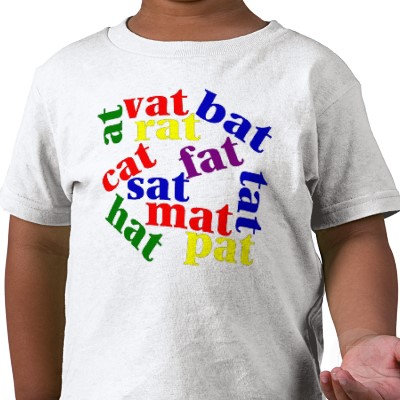
·         When children seem to have a firm grasp of all the letters, start introducing more letters.  For example, start with AT and add an S to the beginning (SAT) or an M (MAT), etc.  Here are some words to try:
o   AD- MAD, DAD, PAD, SAD, TAD
o   SA- SAT, SAD, SAM, SAP
o   MA- MAT, MAP, MAN, MAD

I hope these activities have helped!  Now, back to the read-alouds.  I will try to incorporate a lesson for each step of phonological awareness with each new book.

Happy reading :)

Tuesday, January 25, 2011

Phonemes


Remember to check out these posts if you're new!  I've been breaking down phonemic awareness steps towards reading.  Read these to find out where your child is in this process!

Phonemes are the smalles units of speech.  They are difficult to recognize because they are so small and, unlike syllables, they can’t be easily distinguished.  For example, CAT has 3 phonemes /c/, /a/ and /t/.  However, CART also has 3 (/c/, /ar/ and /t/).  It is extremely important for children to hear each sound in words so when they go to sound it out, they won’t miss parts of it.
  • Start off with three letter words.  Give your child M&M’s, Cheerios, blocks or anything small they can push.  Model pushing one object forward whenever you hear a sound.  For example, if you use the word HAD, you would push forward an object for /h/ as you said it, one for /a/ as you said it and another for /d/.  We call this “Push and Say.”  Try some of these words, but always demonstrate first: 
    • DAY (/d/ and /ay/), HAY, WAY
    • BEE (/b/ and /ee/), FEE, SEE
    • BYE (/b/ and /ye/), WHY, MY, PIE
    • BOW (/b/ and /ow/), GO, MOW, LOW, ROW
    • CHEW (/ch/ and /ew/), STEW, BLUE
  • See if your child can determine whether a word has 2 or 3 phonemes.  Say words like the ones mentioned above, but don’t demonstrate “Pushing and Saying.”  See if they can tell you how many different sounds they hear.  Be sure to throw in words including digraphs (th, ch, sh), where 2 letters make one sound.
  • Next, see if your child can add or subtract initial sounds.  Ask them to tell you the difference between NO and SNOW (the “s” sound at the beginning).  Try these words:
    • TWO and STEW
    • ROW and CROW or GROW
    • CRY and DRY, FRY or TRY
    • PIE and SPY
    • LAY and CLAY or PLAY
    • LOW and BLOW or GLOW
    • RAY and GRAY, PRAY or TRAY
    • Do the same activity removing middle sounds.  Try these words:
      • SO and SLOW, SNOW or STOW
      • DIE and DRY
      • SAY and STAY or SWAY
      • see AND ski
      • CLUE and CREW
      • SIGH and SKY, SLY, SPY or STY
      • GO and GLOW or GROW
      • FEE and FLEA or FREE
      • Once they’ve mastered three letter words, move onto playing "Push and Say" with four letter words.  Try words like: spice, smile, spill, fork, steak, sand, flake, trace, snail, plane, etc.
      • Find pictures of these words in magazines or online.  Play a guessing game where the child has to point to the picture with 3 sounds, or 4 sounds, etc.
      • This website is good for hearing and identifying middle sounds... For example, the O in NOT
      • In this online game , choose which phoneme you want to practice from a list, then your child must match the sound with the printed letter
      • And here  you can make real and made up words with any ending sound
      Anybody reading any good books or doing any fun activities?

      Sunday, January 23, 2011

      Initial and Final Sounds- Alpha and Omega


      This segment is for those children who understand words and sentences and are ready to start reading on their own!  Typically, these are Kindergarten aged kids, but a lot of Pre-K kids will be ready, too!  
      If your child isn’t quite here yet, try these previous blogs:
      Listening (earliest stage)
      Rhyming (2-4 year olds)
      Words/Sentences (4-6 year olds)
      and Syllables (5-7 year olds)
      **Please note that these are all rough estimates of age**
      Phonemes are defined as the individual sounds within words.  This does not necessarily refer to just the different sounds that each letter makes, but also combinations of letters that make one sound (ch, th, etc.).  By starting to look at the beginning and ending sounds, you can lead your child to guess what might fit in the middle.  However, you can do your child a big favor by starting to introduce metacognitive skills at this point.  By that, I mean help your child think about what they’re doing.  If your child guesses a word and it’s wrong, ask him/her “does that make sense in the sentence?”  This will help them later when encountering more challenging words.  

      Here are some activities:

      Start collecting objects!  You can use shoeboxes, cups or a containers like this:

       to store them.  Label each with a letter of the alphabet.  When you find an object that starts with that letter, put it in the box/container.  This can be an activity that is extended over months.

      Play the guessing game.  Choose a book with limited words on each page.  While you’re reading, pick out a word on the page, but DON’T tell your child.  For example, choose a simple word like SAT.  See if he/she can guess your word by only telling them it starts with the /s/ sound and ends with the /t/ sound.  Do not actually say the letters, but rather the sounds they make.

      Point out that several words will begin with the same sound.  Find a page in a book that has a few words that begin with a certain letter.  Ask your child to find all those words.  Or, find some magazines and start cutting out pictures that start with the same sound.  Once your child has mastered initial sounds, do the same activity using final sounds.

      The Bag Game- Place some objects in a bag without your child seeing.  Give them clues until he/she can guess the object.  Always start off giving the initial phoneme of the words you have in mind.  Then, give clues about the object.  For example, if your object is a cup, say it starts with a /c/ sound and you drink from it.

      See if your child can guess which sound you take away from words.  Say the entire one syllable word, then leave off the initial sound.  See if he/she can guess which sound you omitted.  For example, say PIN... then say IN.  See if he/she can come up with P being the missing phoneme.  Try words like FOX, MAKE, RACE, PHONE, SINK, SEAT, FEEL, HAND, etc.  Do the same thing, but now leave off the final sound.  For example, say FREEZE then say FREE.  Try some of these words: BARK, SHEEP, NOTE, NOSE, GREAT, GRAPE, etc.
      I have two more steps of phonemic awareness I want to hit on before going back to giving you great read-alouds!  


      Remember, this is a FABULOUS resource for parents and teachers alike, and where I am getting most of my information!

      Friday, January 21, 2011

      If You’re Happy and You Know It Clap Your Hands


      Syllables- PreK-Kindergarten Kids


      Once children understand that sentences are composed of several words in a certain order and that these words can have multiple sounds within them, it’s time to introduce syllables.  Although technically syllables have no meaning, in contrast to words, they are still extremely important in a child’s literacy development.  If a child can recognize that PENCIL is broken into PEN and CIL, that will help him/her phonetically sound it out later. 

      Syllables are an easy one to introduce and practice:
      ·        Clap your child’s name or other family members’ first and last names.  Demonstrate before having your child copy.
      ·        Fill a bag with toys, items or pictures that can be easily identified (pencil, spoon, bottle, etc.).  Pull out each object and clap the syllables.  Or, have your child move their hips back and forth each time they hear a new syllable.
      ·        Give your child motion words (waving, wiggling, clapping, eating, etc.) and demonstrate saying them slowly and broken into syllables like WA-VING.  Have him/her not only say the syllables, but act them out.
      ·        This activity seems simple, but it fabulous for teaching kids to put sounds together to formulate a word.  Say a 3-4 syllable word extremely slowly.  In fact, put about 5 seconds between each syllable.  See if your child can tell you that word.

      I also found this craft online.

      Beaded Syllable Name Necklaces

      Beaded syllable name necklaces are a fun craft that teach preschoolers about the number of syllables in their own names.
      Materials: coloring string, letter beads, other beads
      Preparation: Prepare the letter beads for each student by using groups of colored beads for each syllable. For example, the name James contains one syllable so all five letters would be of the same color. The name Oliver, however, contains three syllable so O would be one color, L-I would be a second color, and V-E-R would be a third color.
      Instructions: Give each child a piece of string, their name beads, and some other beads. Help each preschooler string their name beads onto the string. Allow the students to add additional beads to decorate their syllable necklaces. Help the children tie their necklaces. Carefully supervise the preschoolers while working with the beads to avoid choking. These beaded syllable name necklaces can be used to facilitate other syllable activities.
      Next up… Initial and Final Sounds!

      I wanted to break down each part of phonemic awareness so that when I return to giving you great read-alouds with activities, I can list an activity for each step of the process (Listening , Rhyming , Words/Sentences , etc.).  That way, each book can apply to your child!

      If you’re looking for a great read-aloud tonight, I just read my kids “Verdi” by Janell Cannon.  A little advanced, but a great message with beautiful illustrations!

      I probably won't be around until Monday but happy cuddling and reading in the meantime!

      Wednesday, January 19, 2011

      MOO!! CoW (Concept of Word)

      Were these posts too easy for your child?
      If you have a preschooler or child about to enter Kindergarten, this is the post for you!

      One of the first milestones in learning to read is having Concept of Word (also known as CoW).  This means that children can match spoken words to written ones.  Children must understand that spoken words are individual components making up thoughts (sentences).  Here is a YouTube video that shows a little girl taking a Concept of Word test.  The examiner has her memorize the story using pictures before giving her the actual text.  Notice that the adult models how to point to the words before allowing her to try on her own. 

      I saw the cutest video in my M.Ed courses where a little boy was supposed to point to the words on a large chart as he recited “Humpty Dumpty.”  He obviously did NOT have concept of word because he was pointing to the end of the entire song when he had only said up to “Humpty Dumpty sat on a wall.”  I wish I could find that video, but it shows that most kids will move to another word whenever they hear a sound.  Syllables will be an important concept to teach next!

      There are several ways you can help your child achieve Concept of Word.  

      • To start, give them a book they’ve read with you before.  This time, allow them to make up sentences to go with the pictures.


      • Let your child choose a sentence from a book.  Write each word of the sentence on a notecard or Post-it.  Read the cards in the correct order several times together.  Next, scramble them up and show your child how to put them back in the right order.  Finally, scramble them and put your child to the test.  Make sure they say each word as they move it into place.  Note that although your child is probably not actually reading the words on the cards yet (or maybe they can), they have memorized the sentence and can associate words spoken with those written!


      • Go on a word hunt throughout a book to find short words (3-4 letters) versus long words (6-7 letters).  Show your child that words vary in length.


      • PALS is a program the University of Virginia developed to assess children’s literacy development in Virginia.  In my public school, we used it at the beginning, middle and end of the year to make sure kids were on the right path.  They have also developed lessons to help teachers achieve their goals for each child.  Here is a CoW lesson I found on their website: 
        • Compose a sentence.
        • Give your child one cube (M&M, lego, toy, etc.) for each word in the sentence and line them up in a straight line.
        • Show your child how to build the sentence by pushing one cube (or item) up each time you hear a word.  Explain that although a word may have more than one syllable, it is still represented by only one cube (or item) in the sentence.
        • Now let him/her try!
      Do you have any other suggestions?  What do you find to be the hardest part of teaching or getting your child to read?

        Tuesday, January 18, 2011

        The Cat in the Hat Sat on a Mat with a Rat

        Rhyming

        Was this blog not a good fit for your child?  Typically, our (much) more vocal three, four and five year olds fall into the later categories, depending on their literacy development.  Rhyming is another strategy we tend to overlook when helping our children to read.  Rhyming continues to teach children sensitivity to sound.  It teaches them that words with similar endings sound the same and, when they’re working on writing them later, are spelled the same (sometimes).  Although, it is NOT suggested to have them look at spellings in this stage of the game, especially if rhyming words aren't spelled the same (wool and full).

        I found these great online resources so your child can work on advancing his/her literacy as well as technology skills!


        Rhyme Time BINGO (for more advanced learners- looking at spelling)


        Dr. Seuss is hands-down the king of rhymes.  You can’t go wrong with him.  You can visit HERE to check out the Dr. Seuss website to go along with the books you read.  


        I just stumbled on this one today that I love for January- SNOW 

        Or maybe I'm just hoping for a little ;)

        Here are some hints for when reading rhymes:

        • Whisper the non-rhyming words and yell/scream/say in a funny voice the rhymes.  Get your child to join in when he/she catches on.
        • Point out one word on the page that you see has other rhyming pairs.  Have your child move/dance/give you a hug when he/she hears the rhyming pairs.
        • See if your child can come up with other rhyming words besides the ones in the book.  They can even be made up words!
        • You don't even need a book for this one- Have your child fill in sentences with a rhyming word.  For example, say "A hat fell on a _______." or "We drove in the car to _____."
        • From Phonemic Awareness in Children , play The Ship Is Loaded with... Basically, you say "The ship is loaded with cheese."  Then, your child must say "The ship is loaded with _______ (please, sneeze, etc.)."
        • You can even make your own rhyming book with pictures (or words, depending how advanced).  Search in magazines or newspapers (the comics usually have bright pictures of random items) for rhyming words.  Glue them on construction paper.
        This still too easy for your child?  Stay tuned...